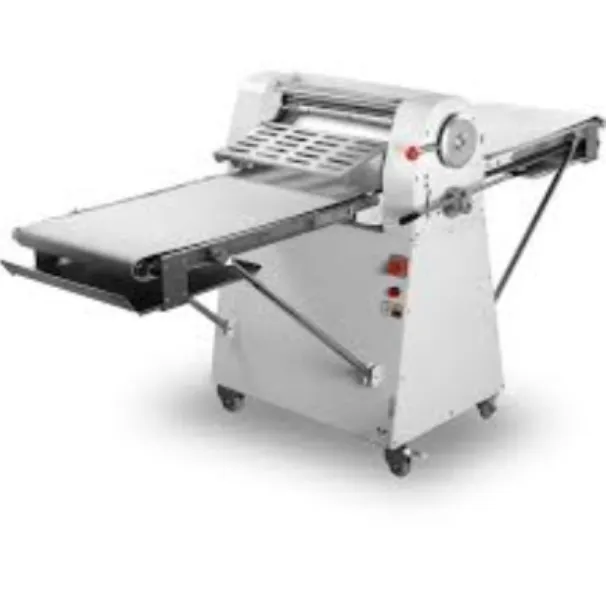
Rolling dough by hand may work for small batches, but maintaining consistent thickness becomes more difficult when production grows. Commercial bakeries, cafés, pastry kitchens and food-production units often consider mechanised sheeting when manual rolling begins restricting output.
A Dough Sheeter Machine can improve repeatability, but selecting the wrong configuration can create new production problems. Avoiding a few common buying mistakes can make the investment more practical.
Mistake 1 Choosing Only by Maximum Capacity
Large capacity can sound attractive, but equipment should suit the normal batch size and available workspace.
A machine that is unnecessarily large may complicate workflow, while an undersized machine can become a bottleneck.
Measure production needs before comparing models.
Mistake 2 Ignoring the Type of Dough
Different doughs behave differently during sheeting.
Pastry, pizza bases and other products can vary in hydration, elasticity, fat content and required finished thickness. Buyers should explain their main application when discussing machine suitability.
A Dough Sheeter Machine should be evaluated against the actual dough being processed rather than a generic description.
Mistake 3 Forgetting About Thickness Control
Consistency is one of the main reasons businesses move away from manual rolling.
Check how thickness is adjusted and whether operators can reproduce settings between batches. Repeatable thickness can improve portion consistency and subsequent shaping or baking.
Mistake 4 Failing to Measure Available Space
Commercial kitchens in Nagpur often need to fit several machines into a limited production area.
Consider not only the machine dimensions but also the operating space required around it. Staff need room to feed dough, collect sheets and clean equipment safely.
Mistake 5 Overlooking Cleaning
Flour and dough residue can accumulate during regular production. Understand how contact surfaces and accessible machine areas should be cleaned.
A complicated cleaning process can reduce the time saved during production.
Mistake 6 Treating Price as the Only Decision Factor
Purchase price should be compared with expected workload, construction, ease of operation and suitability for the intended application.
A lower-cost machine that cannot comfortably handle regular production may prove less economical over time.
Lipsa Impex supplies bakery and commercial food-processing equipment for businesses in Nagpur, Maharashtra. Sharing product type, approximate batch size and daily production requirements can help narrow the equipment options before purchase.
The most suitable sheeter is not necessarily the biggest or most feature-heavy model. It is the machine that produces the required dough thickness consistently, fits the available production area and handles the bakery's realistic daily workload.
Keywords