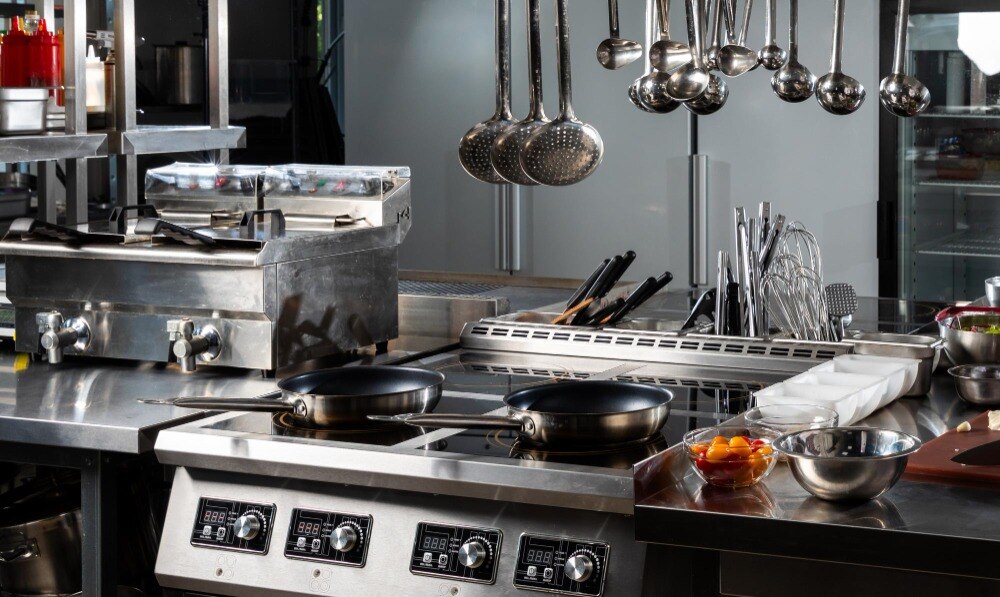
A hotel kitchen dealer must understand simultaneous service pressures, site utilities and the cost of downtime—not just quote machines with attractive output figures. By the end, you will have a practical way to test a dealer’s technical competence, compare complete installation costs and tie payment to measurable performance.
Key takeaways
- Model equipment for your busiest 60-minute service window.
- Match every item to available power, gas, water and drainage.
- Put installation, warranty, response times and spare parts in writing.
- Test capacity, safety controls and cleaning access before handover.
Can the dealer size equipment around your busiest service period?
Ask the dealer to model your busiest 60-minute service window, not merely quote a machine’s rated output. A credible proposal maps the hotel kitchen workflow across simultaneous breakfast service, banquet production capacity, room-service tickets and restaurant covers, then shows where each item is used, cleaned and handed off.
Request a load schedule that records:
- Meals, covers or orders by service and by 15-minute interval
- Batch size, cooking or washing cycle time, recovery time and usable holding time
- Oven, fryer, griddle, dishwasher, refrigeration, ice-maker and hot-water demand during the same peak period
- Bottlenecks created by staff hand-offs, loading, unloading, cleaning and replenishment
- Spare capacity if one critical unit fails or a late banquet wave arrives
Test the arithmetic yourself. Required output equals peak-hour demand divided by usable production time; subtract loading, unloading, recovery and cleaning, rather than using the headline litres-per-hour or trays-per-batch figure. Ask the dealer to demonstrate how the proposed equipment meets peak-hour demand while another station is being cleaned or serviced.
A proposal that sizes only the breakfast kitchen can leave banquet production short at lunch. Look for redundancy or a bypass plan for refrigeration, ice production, dishwashing and cooking, plus clear access to clean and repair each unit without shutting down the entire line.
A slightly less efficient machine can be the safer choice when its failure does not stop service.
Does the proposal match your site utilities and real production requirements?
A proposal is usable only when its output matches the hotel’s peak demand and the building can support it. Require an equipment capacity calculation based on meals per service, batch size, preparation time, holding time, recovery time and simultaneous loads—not a brochure’s headline litres-per-hour figure.
Ask for a utility matrix for every proposed model. It must state:
- Electrical phase, voltage, frequency, connected load and amperage
- Gas type, inlet pressure and connection standard
- Water flow, inlet temperature, drain size and waste connection
- Ventilation, heat rejection, clearance and service-access requirements
- Actual manufacturer, model number, country of origin and production lead time
Compare single-phase versus three-phase supply against the installed distribution board before ordering.
| Option | Check | Risk if mismatched |
|---|---|---|
| Single-phase | Confirm voltage, frequency, amperage and circuit capacity | Overloaded circuits, nuisance trips or unusable equipment |
| Three-phase | Confirm phase sequence, voltage and isolator arrangement | Motors may rotate incorrectly or fail to start |
| Gas-fired | Match the exact model to local fuel, pressure and approval requirements | Poor combustion, unsafe operation or failed inspection |
Do not accept “delivered and undamaged” as commissioning. Put measurable tests in the quote: cooking temperature reached within a stated time, refrigeration temperature maintained under defined ambient load, warewasher rinse temperature or chemical concentration achieved, and electrical, gas-leak, noise and sanitation checks passed.
Include spare capacity or a bypass plan for refrigeration, ice, dishwashing and cooking lines.
Will the dealer coordinate installation, ventilation, water and compliance?
Before delivery, require a signed site-readiness pack for every proposed model. It must show electrical phase, voltage, amperage, frequency, 380 V compatibility, gas type and pressure, water flow, drain size, ventilation requirement, heat rejection and required clearances. Imported equipment can become unusable when its frequency, gas pressure or connection standard differs from the site.
1. Make the dealer identify responsibility for anchoring, gas installation, electrical connections, calibration, refrigeration start-up, exhaust interlocks, operator training and final performance testing. Put each duty, completion date and acceptance test in the quotation rather than relying on a verbal promise.
2. Require coordinated kitchen-exhaust drawings for every ventilation-dependent appliance. Check hood size, exhaust volume, grease-duct route, fire suppression and make-up air against NFPA 96 where it applies, plus the destination jurisdiction’s building and fire rules.
Confirm that the exact gas model and fuel configuration have the required local approval; a CE or UL mark alone does not prove that.
3. Obtain written water treatment requirements for steamers, combi ovens, ice machines, warewashers and coffee systems. Confirm limits for hardness, chloride, silica, total dissolved solids and sediment, then price filtration, softening, reverse osmosis and cartridge replacement where required. Poor water treatment creates scale, contamination risks and early failure.
The dealer should also confirm permits, inspections and a hygienic drainage arrangement before dispatch. Ask for a commissioning record proving safe operation, temperatures, pressures, interlocks and cleaning access—not merely delivery to the loading bay.
What service, spare-parts and warranty commitments are written into the quote?
Do not accept “full support” as an after-sales promise. Require a written hotel kitchen after-sales support schedule covering who receives breakdown calls, the warranty response time, remote diagnosis, on-site arrival target, labour, travel and escalation when the first repair fails.
The quote should attach a spare-parts plan for the first several years. Check that it identifies:
- Parts held in regional or local stock
- Normal and expedited delivery times
- The policy for discontinued parts and replacement models
- Exploded diagrams and service-manual access
- Whether parts are supplied under warranty, on loan, on consignment or for customer purchase
Separate the manufacturer warranty from the dealer’s service obligation. The contract must name warranty exclusions, including water quality, incorrect installation, consumables, cleaning chemicals and misuse, then identify who files the claim and who pays while the claim is reviewed.
A five-year parts warranty does not keep a refrigerator running if the dealer takes ten days to attend.
Ask Lipsa Impex, or any competing dealer, to state these commitments against each critical machine rather than placing one generic sentence on the final page. Compare the promised response with your busiest service period, not office hours.
Also assess equipment maintainability. Ask whether staff can reach filters, pumps, heating elements and control panels without dismantling a production line, and request a bypass or backup plan for refrigeration, ice, dishwashing and cooking. A cheaper machine that immobilises the kitchen during cleaning or repair can cost more than its purchase-price saving.
Related products
 | 220 V Stainless Steel Dough Sheeter Pressing Machine 220 V Stainless Steel Dough Sheeter Pressing Machine Voltage 22O V Material Stainless Steel Capacity 350 kg/hour Power 100 kW Automation Grade Semi Automatic Usage/Application Bakery Product... View product → |
 | Rice Cooking Machine Engineering Model Gas Operated 24 Tray Rice Cooking Machine Engineering Model Gas Operated 24 Tray Our Commercial Rice/Idli Steamer is designed for heavy-duty industrial and commercial kitchen operations. View product → |
How should you compare bids and accept the completed installation?
Compare bids using the same boundary and calculate the total delivered cost, not the equipment price alone. Ask each dealer to state the Incoterm and identify who pays at every hand-off.
| Cost area | Include in the comparison | What it exposes |
|---|---|---|
| Equipment and delivery | Machine, freight, insurance, duties, customs brokerage, inland delivery and rigging | Whether an imported price is genuinely competitive |
| Installation and start-up | Anchoring, gas and electrical connections, commissioning, exhaust modifications and water treatment | Costs hidden behind an “installed” promise |
| Ownership and close-out | Software or subscriptions, training, spare parts, cartridge replacement and disposal of replaced equipment | First-year and replacement costs |
Treat commissioning as part of the purchase. The quote must assign responsibility for calibration, exhaust interlocks, refrigeration start-up, operator training and final performance testing.
Reject a generic “NSF approved” statement. Request the certification listing for the exact model, options and accessories, then confirm that it covers your intended use. For ventilation-dependent equipment, review coordinated drawings covering hood sizing, exhaust volume, grease ducts, fire suppression and make-up air under NFPA 96.
Specify water limits for hardness, chloride, silica, total dissolved solids and sediment, with filtration, softening or reverse osmosis priced where required.
Make acceptance testing a signed condition of payment. Test cooking heat-up time, refrigeration temperature under a defined ambient load, warewasher rinse temperature or chemical concentration, noise, leaks, electrical safety and sanitation. Failed results require correction and retesting.
Frequently asked questions
How can you tell whether a dealer has sized equipment correctly?
Ask the dealer to model your busiest 60-minute period, including breakfast, banquets, room service and restaurant covers. The proposal should show each item’s workload, handoff point and cleaning cycle.
What site details must a hotel kitchen equipment proposal include?
Check the proposal against your actual electrical supply, gas connection, water pressure, drainage, ventilation route, floor space, access route and production volumes.
What installation responsibilities should the dealer confirm?
Require a written scope covering delivery, positioning, assembly, ventilation coordination, plumbing and electrical connections, testing, staff training and compliance documentation.
What service and warranty terms belong in the quotation?
Ask for the warranty period, exclusions, service response time, labour coverage, spare-parts availability, preventive maintenance schedule and escalation contact in writing.
How should you compare dealer bids and approve the completed installation?
Compare usable capacity, utility loads, installation scope, service terms, total ownership cost and exclusions. Before handover, test every machine under operating conditions and record defects, manuals, certificates and training.
Related products
 | 110 V Stainless Steal Dough Sheeter Roller Machine 110 V Stainless Steal Dough Sheeter Roller Machine Voltage 110 V Material Stainless Steel Capacity 700 kg/h Usage/Application Bakery Automation Grade Automatic Power 0.75 kW Product Description: 700... View product → |
 | Rice cooking machine 8 Tray ELECTRIC Rice cooking machine 8 Tray ELECTRIC Our Commercial Rice/Idli Steamer is designed for heavy-duty industrial and commercial kitchen operations. View product → |
 | 380 V Commercial French Fry Cutting Machine 380 V Commercial French Fry Cutting Machine Usage/Application Commercial Material Stainless Steel Type of Cutter French Fry Cutter Weight 110 Kg Voltage 380 V Capacity 600 Kg/h Product... View product → |
 | 100 L Stainless Steel Cooking Machine 100 L Stainless Steel Cooking Machine Capacity 100 L Material Stainless Steel Weight 30 Kg Power 5000 W Voltage 220 V Usage/Application Food Processing Product Description: Large 100L... View product → |